
A few months ago, I would have told you that AI was impressive, but still mostly a novelty—great for drafting emails, summarizing documents, and occasionally helping debug code. Useful, sure. Revolutionary? Not quite. But last week, I had my perceptions and opinions completely upended.
While waiting for the person running one of our regular analysts’ Teams session to deal with a technical glitch, we engaged in some analyst chitchat. During this, Robin Bloor, the founder of Bloor Research, described some coding he was doing with the latest release of Claude, Version 4.6 from Anthropic. I was left speechless!
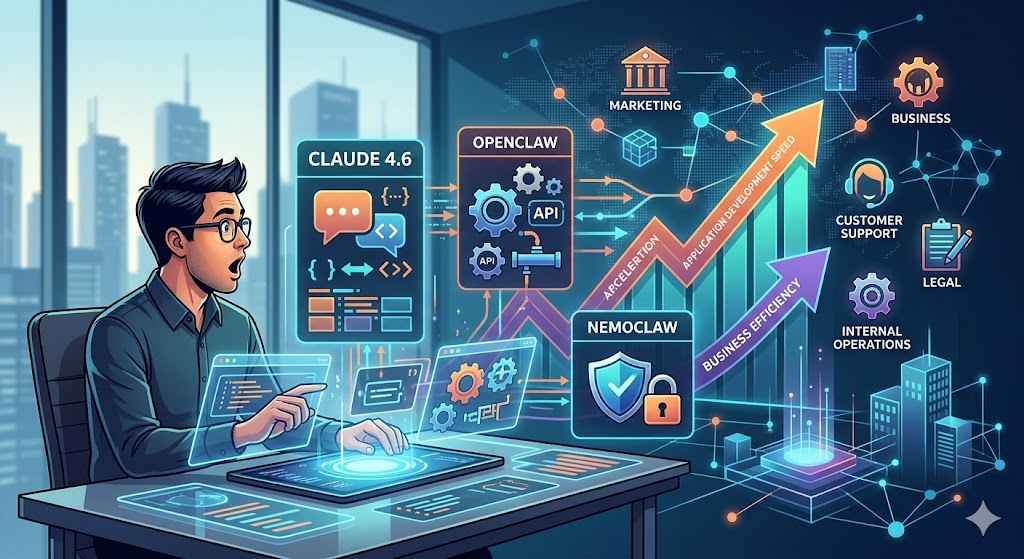
Robin described the pace of improvement he is seeing in tools like Claude 4.6, OpenClaw, and NemoClaw that I honestly found shocking. What used to feel like “smart autocomplete” is now starting to feel like a genuine shift in how software gets built and how businesses operate. And I hadn’t appreciated how fast that transition might now happen.
From Helpful to Game-Changing
The most surprising part isn’t that these systems are getting better—it’s how quickly they’re moving from being assistants to becoming actual collaborators.
For Robin, Claude 4.6, for example, feels dramatically more capable than earlier versions. It’s not just answering questions or generating code snippets. It can hold context longer, reason through complex problems, and provide structured output that resembles the work of a team of experienced developers. With a caveat about the need to give Claude clear architectural input, Robin trusted its ability to improve workflows and deliver clean code, at a a pace he couldn’t possibly match.
Then there’s OpenClaw and NemoClaw, which seem to be pushing things even further by focusing on speed, tool integration, workflow automation and, in the case of NemoClaw at least, security and governance. These aren’t just models you chat with—they’re starting to behave like systems you can build on top of. That difference is enormous.
The Way We Build Applications Is Changing
What really hit me was realising how much application development is being compressed. Tasks that used to take a team of developers—writing boilerplate code, building APIs, generating test cases, creating documentation, setting up CI pipelines—can now be accelerated in a way that feels borderline unreal.
Instead of spending weeks building a prototype, you can now generate a functional proof-of-concept in days, sometimes hours. Not because you’re cutting corners, but because the repetitive parts of engineering are being absorbed by these AI-driven tools.
It’s like we’ve gained a new layer of abstraction—only instead of abstracting hardware or operating systems, we’re abstracting chunks of human labour.
Business Strategy Is About to Be Rewritten
And this is where the shock really turns into something bigger: it’s not just software development that’s changing.
If these tools continue improving at this pace, entire business models are going to shift. Customer support, marketing, product design, internal operations, analytics, legal drafting—suddenly everything becomes faster, cheaper, and more scalable.
The companies that understand how to integrate systems like Claude 4.6, OpenClaw, and NemoClaw into their workflows are going to move at a speed competitors simply can’t match.
This feels less like “adopting a new tool” and more like adapting to a new economic reality.
Exciting… and a Little Unsettling
I’ll admit, part of me is thrilled. This is the kind of technological leap people dream about. But another part of me is unsettled, because it’s happening so fast that it’s hard to keep up.
We’re not talking about slow innovation over decades. We’re talking about noticeable capability jumps in months.
And if that trend continues, we may soon look back at today’s way of building apps and running businesses the same way we now look at dial-up internet: functional, but painfully outdated.
One thing is clear: Claude 4.6, OpenClaw, and NemoClaw aren’t just improving. They’re redefining the playing field. And whether we’re ready or not, the future of development and business is arriving faster than anyone expected.
by Paul Bevan – Tech Industry Forum STAR Group advisory council member
Contact us, if you want to know more, at our contact us page, or email info@cloudindustryforum.org