
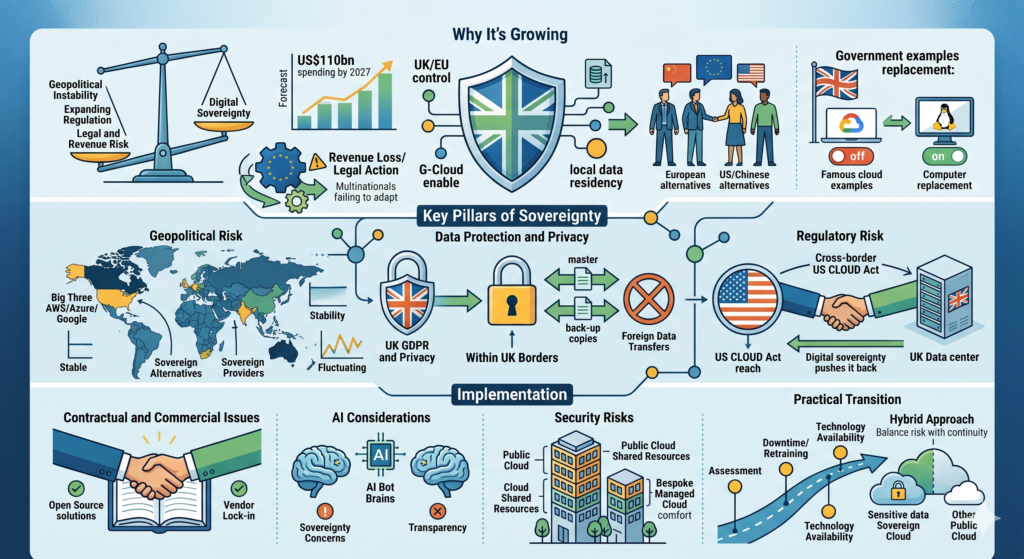
The movement towards “sovereign cloud” solutions is growing. UK business leaders need to understand the legal implications of this transition.
What is sovereign cloud and why is it growing?
Sovereign cloud means moving data, hosting and software from overseas providers to UK or EU alternatives.
Geopolitical instability, expanding regulation and legal and revenue risk have turned digital sovereignty from a compliance choice into a mainstream enterprise requirement.
Gartner forecasts global sovereign cloud spending will reach US$110bn by 2027 and warns that 30% of multinationals face revenue loss, brand damage or legal action if they fail to address digital sovereignty risks.
The EU Commission launched a €180 million sovereign cloud tender. The UK’s G-Cloud 15 does not mandate sovereign cloud but actively enables it.
Key US providers have responded by launching ‘fully disconnected’ local sovereign operations with EU‑based parent companies, EU‑only leadership, independent advisory boards and continuity mechanisms.
This is too late for some. In late 2025, Schleswig-Holstein moved 30,000 government employees off Microsoft entirely. France ordered its 2.5 million civil servants to replace Microsoft Teams and Zoom with the French-built Visio platform by 2027 and is shifting to Linux desktops.
Data Protection and Privacy
Data residency sits at the heart of sovereign cloud. UK GDPR and EU GDPR permit personal data transfers with safeguards, but public cloud providers do not always let organisations control where master or back-up copies are stored. Organisations must implement ‘appropriate technical and organisational measures’ when transferring data outside the UK or EEA. This means not just contractual clauses but actual assessment of the recipient. That is harder with a foreign cloud provider. Keeping data in the UK sidesteps these issues.
Geopolitical Risk
The ‘Big Three’ AWS, Azure and Google hold over 60% of worldwide cloud infrastructure, with much of the rest held by other US and Chinese providers. Shifts in the global political landscape have led organisations to question provider stability. Tariffs and currency fluctuations create price instability; worst-case scenarios could mean sudden loss of service.
Regulatory Risk
Foreign laws can reach across borders. The US CLOUD Act governs any technology company with a US presence, including public cloud providers. If requested by authorities, vendors must hand over any data they control, including non-US data. Vendors can challenge such requests, but the risk remains. Digital sovereignty ensures only locally governed entities handle data.
Contractual and Commercial Issues
Vendor lock-in remains a significant risk, whether from minimum term contracts, proprietary solutions or customer resistance to change. Open-source solutions offer transparency and reduce lock-in. These issues should inform procurement and contract negotiations.
AI Considerations
AI use is increasing, but most tools come from US providers with the same sovereignty concerns. Anthropic is pushing back against US Department of Defence demands that would ‘undermine, rather than defend, democratic values’. That battle aside, most UK organisations have little transparency or control over their AI tools.
Security Risks
Cybersecurity is increasingly central to cloud strategy. Public clouds use multi-tenant architecture with shared resources. Vendors take extensive steps to isolate data, but if an attacker breaches the vendor’s infrastructure, customer data may be at risk. Customers now consider whether a bespoke or managed cloud closer to the business offers more comfort than encryption alone.
Practical issues of Transition
Migration brings its own risks. Organisations should assess operational and financial implications: downtime, retraining and technology availability. A hybrid approach to migrate sensitive data to sovereign solutions while keeping other workloads in the public cloud may balance risk with operational continuity.
What do Tech Industry Forum members think?
Emma Dennard, VP Northern Europe of OVHcloud says “Sovereignty is a complex, multi-dimensional issue. We tend to see organisations separating it into three aspects: data, which includes handling and legal considerations, technical, including the freedom to move data and the technological ‘supply chain’, and operational, which includes physical residency and the human side of data handling.
Although the last year has been a difficult one for organisations around the world, more businesses are now taking a methodical, considered approach to sovereignty, profiling data and workloads to understand their security, risk and operational needs, and specify the appropriate hosting environment accordingly.”
James Marks, Founder and CEO of Canopy adds “European digital sovereignty is reshaping the future of cloud computing. The question is: Are organisations ready for the transformation that regulators and markets demand? The competitive landscape is shifting as new compliance frameworks accelerate the race for operational independence, regulatory certainty, and digital trust.
Global interest is exploding: analysts forecast the sovereign cloud market will soar from $96.77 billion in 2024 to nearly $650 billion by 2033, with Europe at the forefront of this rapid transition. While US hyperscalers maintain dominant market share, European providers like Deutsche Telekom, OVHcloud, SAP, and Orange are evolving to meet the sovereignty challenge. “
What next?
Sovereign cloud is no longer niche, it is becoming a strategic imperative for UK and EU organisations.
Legal advisers play a critical role in navigating data protection, contractual, IP and geopolitical complexities. Organisations should rigorously assess their business priorities, regulatory requirements and technological needs to inform any migration decision. With proper due diligence and careful contract drafting, organisations can realise the benefits of digital sovereignty while managing legal risk.
By Frank Jennings, partner at HCR Law, director of Tech Industry Forum – 17 April 2026
Contact us, if you want to know more, at our contact us page, or email info@cloudindustryforum.org